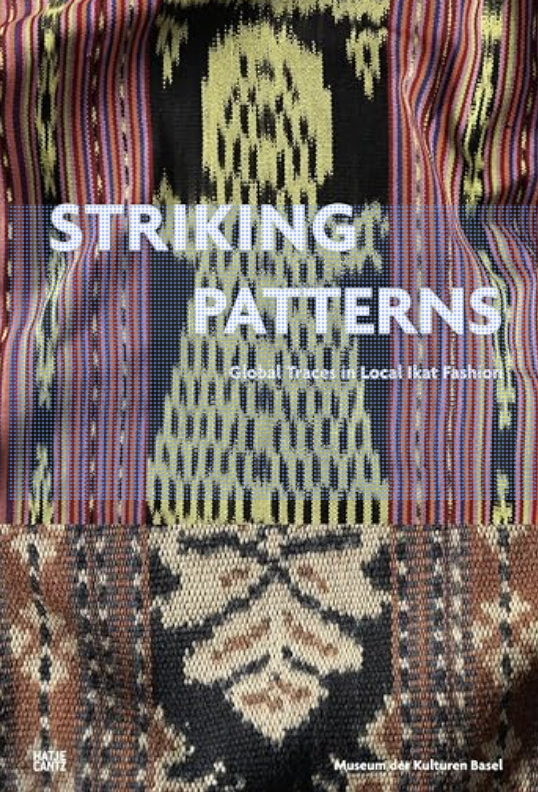
We would like to start with one of the General Assemblies we organized. We were visiting an exhibition of the Museum der Kulturen of Basel Striking Patterns: Global Traces in Local Ikat Fashion (Oct. 2016-March 2017), wandering slowly between immense clothes, whose patterns and colors, did not immediately speak to us. One of the curators, Prof. Willemijn de Jong (UZH) played the role of the translator bringing the stories, the worlds, threaded in these objects, to us. Explaining how Ikat women from Eastern Indonesia integrated ideas of various origins in their textiles. Explaining how textiles are never just textiles, but how these women also created fashion and art (Jong & Kunz 2019). Several years later, at another General Assembly, organized at the Careum Institute in Zurich, we all tried out connected suit simulating how aging feels. The heaviness in the limbs, the moves more difficult, the sight shortened, the hearing blurred. We laughed in relief of getting out of the suit, with sympathy in our hearts, for the vulnerability and the fatigue that may come with years.
Two different fabrics. Textiles telling different stories, from different worlds. One connecting us to a distant area, to women weaving their pasts and futures together, in precarious contexts, women maintaining their sense of identity in a changing world, around weaving. The other connecting us to our future aging self. A high-tech cloth, resulting from the joint expertise of engineers, health professionals, and gerontologists. Both making us feel the world differently. To tell our story of STS, we want to choose these textiles as our objects. Not to implode them in more detail to document how they are in the world, as much as the world is in them (Dumit 2014). But to take them as metaphor, allowing us to focus more closely on what a fabric does, on how it can make different things, how it needs care, and how it may persist, or not, over time. To pay attention to the often invisible work of weaving together threads, that will give rise some time to a pattern in a Ikat textile, others, to a connected simulating costume.
An association, like a fabric, does not maintain itself by itself over time. It wears out, loosens, and sometimes tears. The threads that make it up (people, places, commitments, ideals) wear out at different rates. A decision must then be made: let it go, or pick up the thread. When created, STS-CH was conceived as a fabric to be woven, cared for, and repaired, rather than a framework to be occupied. A fabric designed to connect ways of doing Science and Technology Studies in Switzerland, beyond universities, linguistic regions, and disciplinary affiliations, at sewing them together. A fabric deliberately not affiliated with a single laboratory or institution, to remain mobile, open, and inclusive of STS internal difference and sensibilities.
But no fabric escapes wear and tear. After the founding years and an initial period of consolidation, some of the threads began to fray. The association existed but was in danger of becoming a garment looking nice in the closet but not worn any more: present and legitimate, but without any real influence. As STS laboratories were set up in several Swiss universities, a question arose: should STS-CH follow this institutionalization dynamic or take on a more “uncomfortable” position, maintain an externality enabling it to thread STS together without being itself associated with a specific lab, institution, or version of STS?
The co-presidency of the association between 2013 and end 2017 by Nicholas Stücklin and Emilie Bovet was conceived as a gesture of regeneration and repair. Taking up a fabric again does not mean restoring it to its original state, but accepting that it will be transformed, that new patterns may emerge. Reinforcing certain threads, letting others unravel to allow for a new shape.
A key moment in this reconfiguration was the 2014 Swiss STS Meeting in Lausanne, dedicated to “Collecting, Organizing, Trading Big Data”. It was an ambitious event, strongly supported by institutions: three days of discussions on the production, circulation, and political uses of big data, well before the subject became ubiquitous. In hindsight, this conference could be seen as visionary. But it also raised a crucial question: what to do after mobilizing so much energy? How to prevent the fabric from collapsing once the tension subsided? How to sustain forces and motivations on a long term?
The response given in the small group of STS-CH at that time was not to accumulate ever larger events, but to shift the focus and our ways of making differences. We decided to engage more closely with society, and not just with the university: to hold general assemblies in exhibition venues, organize workshops in asylum seekers’ centers, and attempt to weave STS with politics and societal concerns. This stance for interfering with society, for claiming a capacity for intervention and engagement, for doing, rather than a merely academic stance, involved the risk of being judged by some as too activist or not enough cutting-edge academic, of using STS tools and approaches to make a difference in practice, rather than promoting STS as an academic field per se. Yet, this choice gave meaning to our work and our concepts, and gave strengths to the group for a moment. At some point, though, for institutional and personal reasons, the group dissolved and STS-CH reconnected more strongly with institutional STS, to give it a future.
Even today, STS-CH is not a smooth fabric. And that’s a good thing. It is living. Its revivals tell the story of its hesitations, its commitments, its attempts at inclusivity in a multilingual and institutionally fragmented Switzerland. Above all, they show that an association is held together not only by the strength of its original threads, but by the collective ability to saw revive them, again and again, to maintain, to repair, and create patterns in new ways.
Dumit, Joseph. 2014. « Writing the Implosion: Teaching the World One Thing at a Time ». Cultural Anthropology 29(2):344‑62. doi:10.14506/ca29.2.09.
de Jong, Willemijn, et Richard Kunz. 2019. « Striking Patterns: Contemporary Ikat Design and Its Future ». TEXTILE 17(3):289‑95. doi:10.1080/14759756.2018.1564610.
Jong, Willemijn de. 2021. Arts in the Margins of World Encounters. Wilmington, Delaware: Vernon Press.